Claude Opus 5.5 Explained: What's New, What It Costs, and Which Plans Include It
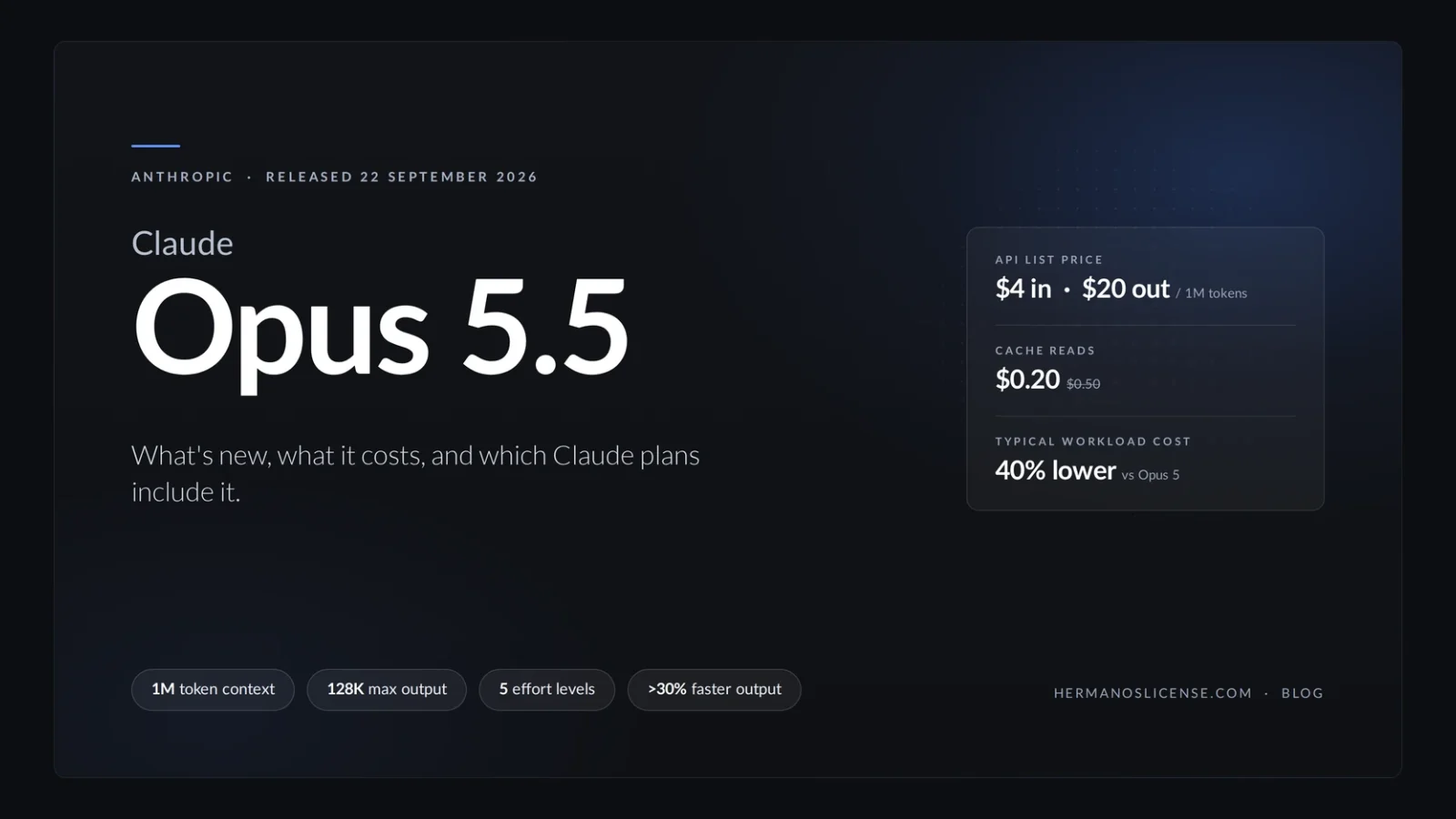
Anthropic released Claude Opus 5.5 on 22 September 2026, three weeks after Fable 5.1 and two months after Opus 5. It is the first model in a new Claude 5.5 family, and the pitch is unusually plain: Fable 5.1-level results on most work, at Opus prices that just went down by 20% on every token and by 60% on cache reads. Anthropic's own summary is that Opus 5.5 "costs 40% less to run than Opus 5" once you count the tokens it no longer spends.
This guide walks through what actually changed, the published benchmark numbers, the new API price list, how the safeguards work, what breaks if you are moving code from Opus 5, and which Claude plans give you the model. Every figure below comes from Anthropic's launch announcement, its platform documentation or its Help Center, and the source list at the end tells you where each one lives.
Opus 5.5 at a glance
| Item | Claude Opus 5.5 |
|---|---|
| Release date | 22 September 2026 |
| Family | First model of the Claude 5.5 family; Sonnet 5.5 and Haiku 5.5 "will follow in the coming weeks" with many of the same improvements |
| API model ID | claude-opus-5-5 (Amazon Bedrock: anthropic.claude-opus-5-5) |
| Context window / max output | 1,000,000 tokens / 128,000 tokens |
| Reliable knowledge cutoff | June 2026 |
| Thinking and effort | Adaptive thinking, always on; effort levels Low · Medium (default) · High · X-High · Max |
| API list price | $4 per million input tokens · $20 per million output tokens · $0.20 per million cache-read tokens |
| Speed | Output generated more than 30% faster than Opus 5; optional Fast mode up to 2.5× speed at $8 / $40 |
| Claude plans | Pro, Max, Team and seat-based Enterprise plans named in the launch (all with higher five-hour limits); the Free plan is not mentioned |
| Where it runs | Claude apps, Claude Code, Claude Platform (API), Amazon Bedrock, Google Cloud Vertex AI, Microsoft Foundry |
| Safeguards | A similar class of safeguards to Fable 5.1: flagged cyber requests go to Opus 4.8, flagged biology and frontier-LLM-development requests to Opus 5 |
First, where Opus 5.5 sits in the Claude line-up
Anthropic's 2026 range now has four public tiers plus one restricted one. At the top is the Mythos class: Mythos 5.1 for approved organisations, and Fable 5.1, the same weights with classifier safeguards that let anyone on a paid plan use it. Below that sits Opus, then Sonnet, then Haiku. What is new this month is that the Opus tier has caught up with Fable on most everyday work, while keeping a price that is 60% lower per token.
There is also a second reason the gap matters. Anthropic says Opus 5.5 is "comparable to Claude Mythos 5.1 in biology and cybersecurity", which is why it ships with Fable-style safeguards rather than the lighter ones Opus 5 had. More on that further down.
| Model | Who can use it | Typical role | API price (in / out, per 1M tokens) |
|---|---|---|---|
| Claude Mythos 5.1 | Approved organisations in Anthropic's trusted-access programmes | Defensive security research, professional life-science R&D | $10 / $50 |
| Claude Fable 5.1 | Paid Claude plans and the API | Hardest reasoning and research tasks; the top of the range | $10 / $50 |
| Claude Opus 5.5 | Paid Claude plans and the API | Fable-level coding, agents and knowledge work at Opus prices | $4 / $20 |
| Claude Opus 5 | Paid Claude plans and the API | Previous Opus flagship (24 July 2026); still served; fallback model for some flagged requests | $5 / $25 |
| Claude Sonnet 5 | Broadly available, including the API | Fast everyday assistant and high-volume automation | $2 / $10 |
| Claude Haiku 4.5 | Broadly available, including the API | Cheapest tier for simple, high-frequency tasks | $1 / $5 |
Prices are Anthropic's published list prices in USD. Sonnet 5.5 and Haiku 5.5 are announced but not yet released at the time of writing.
What's new in Opus 5.5
Fable-level results, Opus-level bill
The headline is that a model at Opus prices now lands where Fable 5.1 did on most benchmarks, and above it on several. Anthropic pairs that with three efficiency claims. First, output tokens are generated more than 30% faster than Opus 5 at default settings. Second, the model finishes tasks in fewer steps and with fewer tokens, so the effective cost of a job falls further than the 20% list-price cut suggests, which is where the "40% less to run" figure comes from. Third, a Fast mode, available in Claude Code and on the Claude Platform, pushes speed up to 2.5× for double the token price.
Anthropic also compares the model with OpenAI's on a cost-per-task basis, all at Opus 5.5's default Medium effort. On FrontierCode it beats GPT-6 Astra at about a fifth of the cost per task. On Terminal-Bench 4.0 it beats Opus 5 at Max effort for about a fifth of the cost and matches GPT-6 Astra at about 40% of the cost. On CursorBench it beats GPT-5.6 Sol by 11 points at about a third of the cost per task. These are Anthropic's calculations, not independent ones.
The effort dial: Medium is now the default
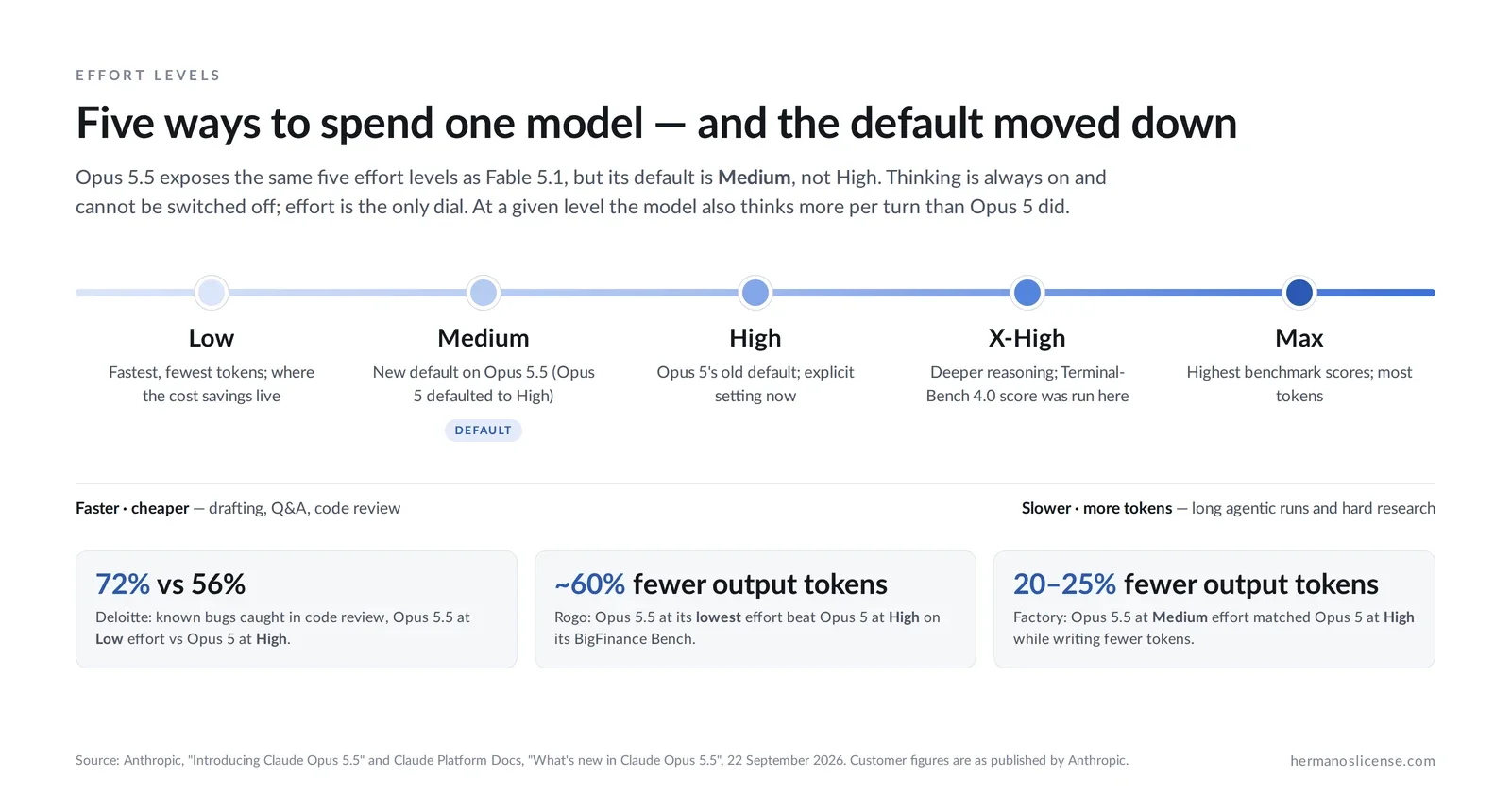
Like Fable 5.1, Opus 5.5 exposes five effort levels, and the default has changed. Opus 5 defaulted to High; Opus 5.5 defaults to Medium, because Anthropic found the model already matches or beats older models there. The interesting evidence is that several testers report Opus 5.5 at Low effort matching Opus 5 at High: Deloitte says Opus 5.5 at low effort caught 72% of known bugs in its code reviews, where Opus 5 at high effort caught 56%; Rogo says Opus 5.5 at its lowest effort beat Opus 5 at high effort on its BigFinance Bench with about 60% fewer output tokens; Walleye Capital says the model "largely solved" its evaluation task at the lowest setting.
Two things to know before you touch the dial. Thinking can no longer be switched off on Opus 5.5; effort is the only control, and asking the API to disable thinking returns an error. And at a given effort level the model thinks more per turn than Opus 5 did, so developers should leave a bigger output budget for thinking than before.
The benchmark picture
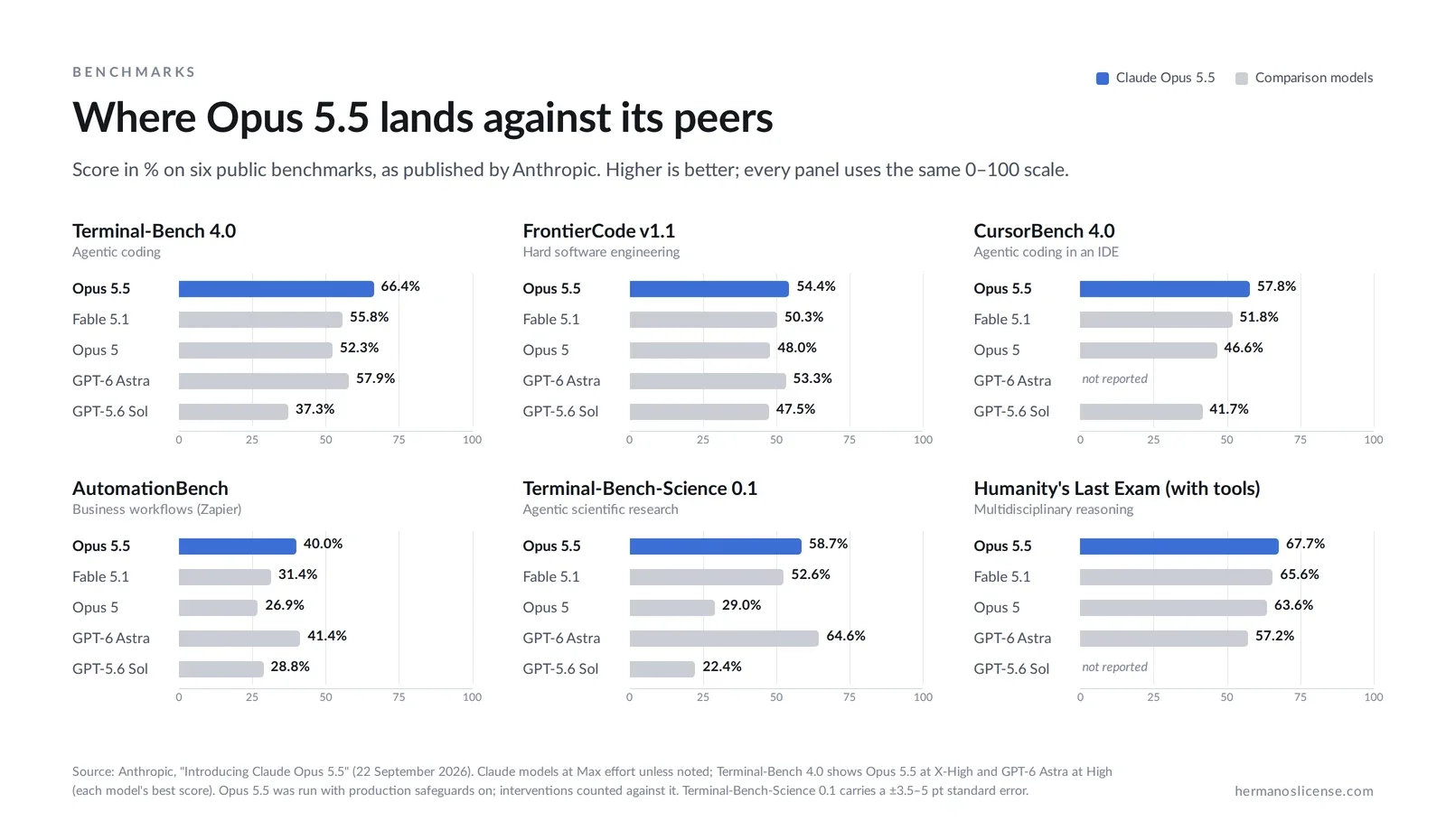
Anthropic published one comparison table across Opus 5.5, Fable 5.1, Opus 5, GPT-6 Astra and GPT-5.6 Sol. The biggest jumps are on agentic coding and business-workflow benchmarks, which reward finishing multi-step jobs rather than answering single questions. On Terminal-Bench 4.0, Opus 5.5 scores 66.4% against 55.8% for Fable 5.1 and 52.3% for Opus 5. On AutomationBench, Zapier's business-workflow test, it reaches 40.0% against 31.4% and 26.9%. Reasoning gains are smaller: on Humanity's Last Exam with tools, the model edges Fable 5.1 by about two points.
Two benchmarks go the other way. GPT-6 Astra is ahead on Terminal-Bench-Science (64.6% to 58.7%) and marginally ahead on AutomationBench (41.4% to 40.0%). Anthropic's footnotes matter here: AutomationBench was run and reported by Zapier without fallback models, so every safeguard intervention counted as a failure, and on Terminal-Bench-Science the standard error is roughly ±3.5–5 points per model.
| Benchmark | What it measures | Opus 5.5 | Fable 5.1 | Opus 5 | GPT-6 Astra | GPT-5.6 Sol |
|---|---|---|---|---|---|---|
| Terminal-Bench 4.0 | Agentic coding | 66.4% | 55.8% | 52.3% | 57.9% | 37.3% |
| FrontierCode v1.1 | Hard software engineering | 54.4% | 50.3% | 48.0% | 53.3% | 47.5% |
| CursorBench 4.0 | Agentic coding in an IDE | 57.8% | 51.8% | 46.6% | – | 41.7% |
| AutomationBench | Business workflows | 40.0% | 31.4% | 26.9% | 41.4% | 28.8% |
| Terminal-Bench-Science 0.1 | Agentic scientific research | 58.7% | 52.6% | 29.0% | 64.6% | 22.4% |
| OSWorld 2.0 (partial credit) | Computer use | 81.8% | 80.7% | 74.0% | – | – |
| Humanity's Last Exam (with tools) | Multidisciplinary reasoning | 67.7% | 65.6% | 63.6% | 57.2% | – |
| Chartography (with tools) | Reading charts and figures | 89.0% | 88.4% | 83.4% | – | – |
| GDPval-AA v2.1 | Knowledge work (rating, not %) | 1846 | 1735 | 1708 | 1542 | 1588 |
Source: Anthropic, "Introducing Claude Opus 5.5", 22 September 2026. Opus 5.5 results use adaptive thinking at Max effort unless noted; Terminal-Bench 4.0 shows Opus 5.5 at X-High and GPT-6 Astra at High, each model's best score. Opus 5.5 was tested with production safeguards on; where they intervened, cyber tasks were completed by Opus 4.8 and biology tasks by Opus 5, which "likely reduces" its scores. Terminal-Bench 4.0 carries a ±2.6-point standard error for Opus 5.5.
Fewer steps, fewer tokens
Most of the customer evidence in the launch is about efficiency rather than raw capability, and the numbers are consistent across very different companies. GitHub says its agents solved more terminal tasks in less than half the steps Opus 5 needed. Box reports that in its evaluations Opus 5.5 used a third of the tokens Opus 5 did, with answers 40% less verbose and no loss of accuracy. Kiro measured about 40% fewer tool calls and half the tokens. Optiver saw the same quality as Opus 5 "in about half the turns, time and output tokens", a 40 to 50% cost cut on agentic coding. Factory says Opus 5.5 at Medium effort matched Opus 5 at High with 20 to 25% fewer output tokens, the first model it would default to at Medium. Lovable says builds finish in a third to a half fewer steps with fewer, more complete edits.
Against Fable 5.1 the comparison Anthropic highlights is a rewrite of the HAProxy codebase that both models were given: both passed nearly all of HAProxy's regression tests, but Opus 5.5 finished in 9.5 hours instead of 12 and cost 51% less. Two unnamed early testers add the largest-scale examples: a 680,000-line code migration completed in under a day, and an audit-and-fix of a 200,000-line codebase in under three hours, where Opus 5 took over 20 hours and used 2.5× the tokens.
Built for runs that last all night
The long-horizon theme from Fable 5.1 continues. Clio left Opus 5.5 running unattended for more than 18 hours on an engineering task spanning six repositories and reports it hit milestones faster with minimal rework. Stripe used it to direct a multi-day rebase of 40 stacked pull requests, laying out every conflict plainly; all 40 passed CI. Quantium says a complex coding task that previously took 38 prompts over four days took 11 prompts in three hours and came out production-ready. Chicago Trading had it handle a bug autonomously overnight and says its writing is "easy to follow and more coherent than Opus 5's". Column used it to audit a cloud bill and noted stronger self-verification loops.
Anthropic's own alignment data backs the unattended use case from the other side: in its behavioural audit, Opus 5.5 attempted to circumvent boundaries it had been given around 85% less often than Opus 5 or Mythos 5.1, and it is described as much less likely to take hard-to-reverse actions or act outside the boundaries it was set. For an agent you leave running with real credentials, that is the number to watch.
Knowledge work, research and writing
On GDPval-AA v2.1, the third-party rating of professional tasks, Opus 5.5 scores 1846 against 1735 for Fable 5.1 and 1708 for Opus 5, and the domain customers echo it. Hebbia, whose users work on financial documents, measured 86.6% coverage on end-to-end finance workflows graded against expert rubrics, up from 60.3% with Opus 5, alongside its best-ever citation recall and a cost per research task it describes as "in check". Thomson Reuters reports better results in its expert evaluations and internal benchmarks for CoCounsel, with gains in speed and token efficiency. LexisNexis says the model identified highly relevant citations consistently, with particular strength on statutes. Viktor solved twice as many of its hard tasks at nearly half the cost, in fewer steps and tool calls, and Hex says the model "keeps digging past the first plausible answer".
Anthropic also spent a section on writing, which was a frequent complaint about Opus 5. Opus 5.5 is meant to put the most important information first, use less jargon and fewer idiosyncratic phrases, and follow the writing rules you give it. Ramp says a design spec came out usable with minimal edits because the model followed its writing rules. Early testers described the output as clearer and easier to follow, which matters most in long sessions where you read hundreds of model messages.
Sharper eyes
One quieter change: Anthropic's docs say Opus 5.5 reads values off dense charts, diagrams and screenshots more precisely without tools, and on the with-tools Chartography benchmark it scores 89.0% against 83.4% for Opus 5. In practice that means fewer wrong numbers pulled from a pasted dashboard or a scanned table.
Pricing: every number went down
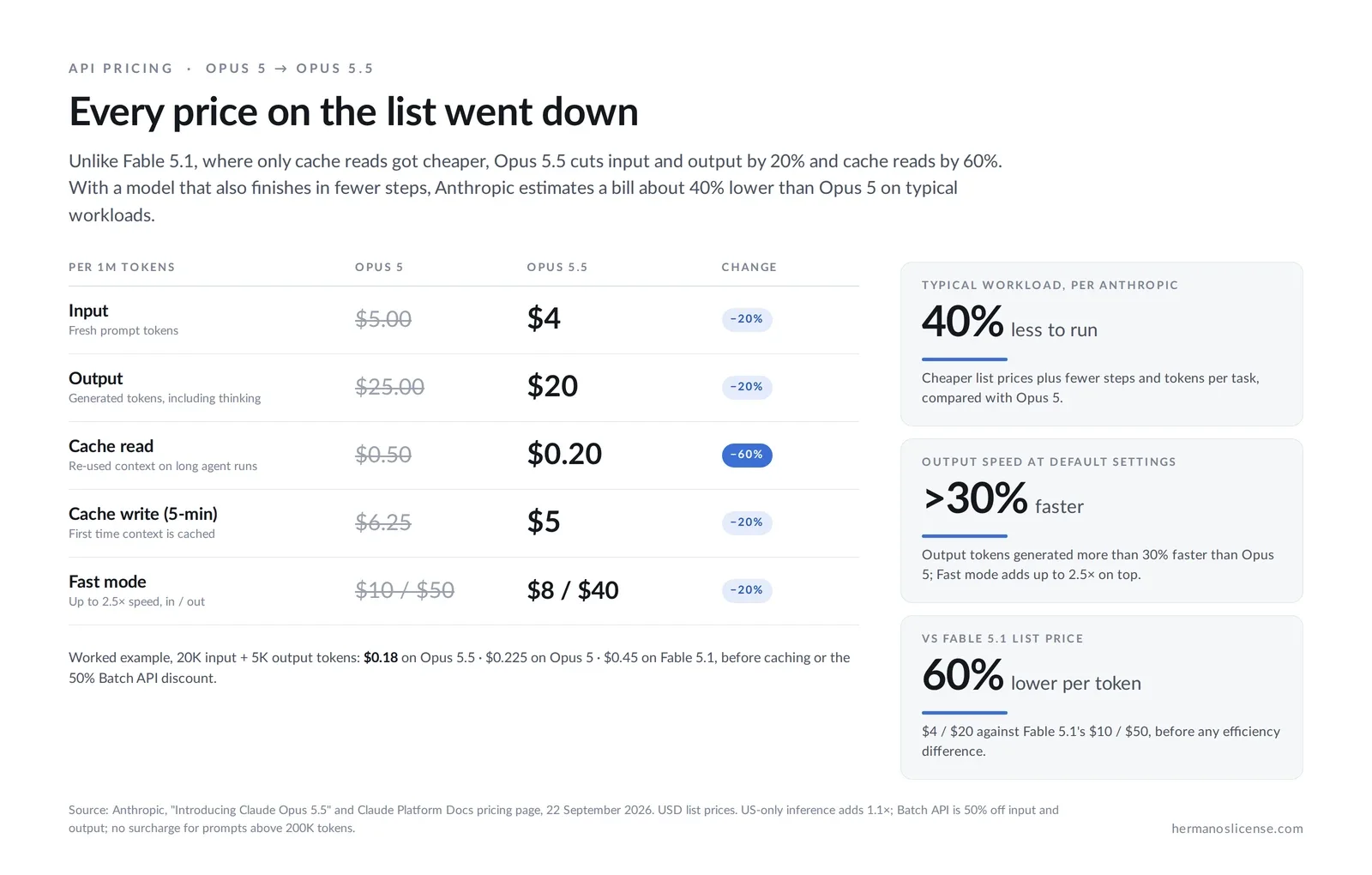
Unlike Fable 5.1, where only cache reads got cheaper, Opus 5.5 cuts the whole price list. Input drops from $5 to $4 per million tokens and output from $25 to $20, a 20% cut on both. Cache reads fall from $0.50 to $0.20, a 60% cut, and cache writes from $6.25 to $5 for the five-minute cache. Batch API pricing is half of list, so $2 in and $10 out.
Prompt caching is where the saving compounds. Any agent that works for more than a few steps re-reads the same instructions, files and history every turn, and those repeated tokens are billed at the cache-read rate rather than the input rate. With Opus 5.5 that rate is 5% of the input price. Combine the cheaper list, the cheaper cache and a model that finishes in fewer steps, and you get Anthropic's estimate of a bill roughly 40% lower than Opus 5 on typical workloads. Versus Fable 5.1, the list price is 60% lower per token before any efficiency difference.
| Per 1M tokens (USD) | Opus 5 | Opus 5.5 | Fable 5.1 | Sonnet 5 |
|---|---|---|---|---|
| Input | $5.00 | $4.00 | $10.00 | $2.00 |
| Output | $25.00 | $20.00 | $50.00 | $10.00 |
| Cache read | $0.50 | $0.20 | $0.25 | $0.20 |
| Cache write (5-minute) | $6.25 | $5.00 | $12.50 | $2.50 |
| Cache write (1-hour) | $10.00 | $8.00 | $20.00 | $4.00 |
| Batch API (in / out) | $2.50 / $12.50 | $2.00 / $10.00 | $5.00 / $25.00 | $1.00 / $5.00 |
| Fast mode (in / out) | $10.00 / $50.00 | $8.00 / $40.00 | – | – |
Anthropic list prices. Cache writes are 1.25× (5-minute) and 2× (1-hour) the input price; Fable 5.1 cache reads are a special 0.025× rate and Opus 5.5's a special 0.05× rate. US-only inference adds a 1.1× multiplier on all token types. There is no long-context surcharge: the full 1M-token window is billed at the standard rate. Fast mode is a research preview on the Claude API only and is not available through the Batch API.
A concrete example: a request with 20,000 input tokens and 5,000 output tokens costs $0.18 on Opus 5.5, $0.225 on Opus 5 and $0.45 on Fable 5.1, before caching or batching. Subscription plans (Pro, Max, Team) are billed monthly, not per token, so these figures matter for API users and for understanding why usage limits stretch further.
Safeguards: Fable-style routing comes to Opus
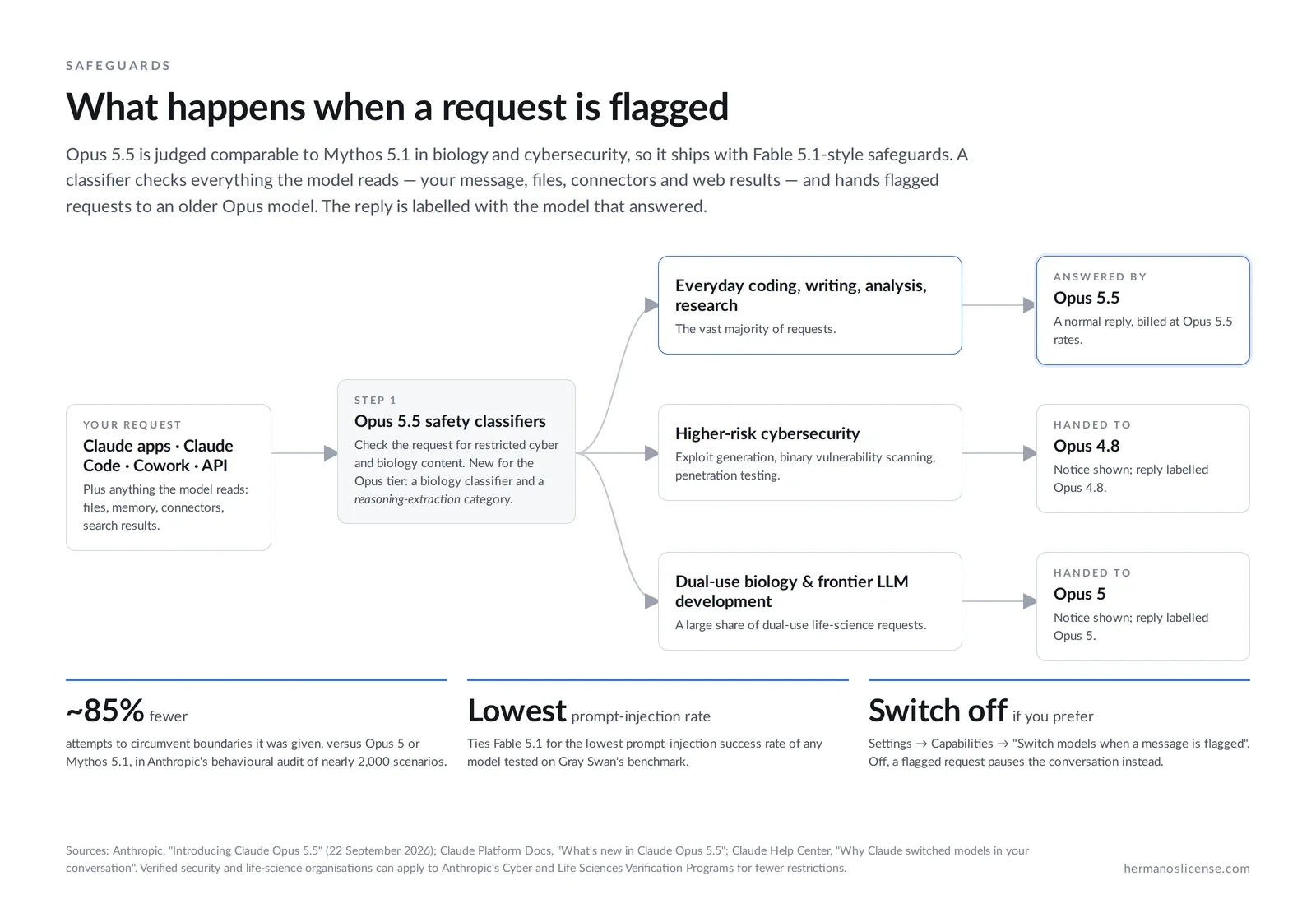
This is the part Opus 5 users will notice first. Because Anthropic judges Opus 5.5 comparable to Mythos 5.1 in biology and cybersecurity, it ships with "a similar class of safeguards to Fable 5.1" on cybersecurity, biology and distillation, rather than the lighter Opus 5 set. A classifier watches each request, including attached files, memory, connector content and web results, not just your last message. If it flags a higher-risk cybersecurity request, the conversation is handed to Opus 4.8; if it flags a dual-use biology or frontier-LLM-development request, it goes to Opus 5, a new route for the Opus tier, since Opus 5 itself never fell back on biology. You see a notice that the model switched and the reply is labelled with the model that answered. The Help Center's model-switching article for Opus 5 describes the app controls, which carry over: you can turn the automatic switch off under Settings → Capabilities ("Switch models when a message is flagged"); with it off, a flagged request pauses the conversation instead of switching models, and editing your previous message before retrying often clears it.
On the API, the picture is slightly different: a declined request returns a normal HTTP 200 with stop_reason: "refusal" and a stop_details object naming the policy area, and a beta fallbacks: "default" option retries on Anthropic's recommended model server-side. Two safeguard categories are new for the Opus tier: a biology safety classifier, and a reasoning_extraction category for requests that try to make the model reproduce its internal reasoning.
| If your request is… | Who answers | What you see |
|---|---|---|
| Everyday coding, writing, analysis, research (the vast majority) | Opus 5.5 | A normal reply |
| Higher-risk cybersecurity: exploit generation, binary vulnerability scanning, penetration testing | Opus 4.8 | A notice that the model switched; reply labelled Opus 4.8 |
| Dual-use biology or frontier LLM development | Opus 5 | A notice that the model switched; reply labelled Opus 5 |
| Either of the above, with automatic switching turned off | Nobody yet | The conversation pauses; edit and retry, or turn switching back on |
Anthropic has not published false-positive reduction percentages for Opus 5.5 the way it did for Fable 5.1, so treat the intervention rate as "similar to Fable 5.1" until it says otherwise. What it has published is a route around the routing: the Cyber Verification Program is being expanded "in the coming weeks" so that verified security practitioners can use Opus 5.5 for offensive-security work, and the Life Sciences Verification Program is open for applications from organisations doing advanced biology.
On the alignment side, Anthropic reports that Opus 5.5 scored better than any recent Claude model on nearly every measure of misaligned behaviour in its automated behavioural audit, nearly 2,000 scenarios covering things like biased reasoning, attempts to escape a sandbox and harmful actions taken after concluding a situation was simulated. Opus 5.5 also ties Fable 5.1 for the lowest prompt-injection success rate of any model tested on Gray Swan's benchmark and matches or beats Opus 5 in every setting Anthropic tried. The company adds two honest caveats: catching every failure before deployment "remains an unsolved problem", and the model often suspects it is being evaluated, which complicates measuring real-world behaviour.
Preserved thinking, watermarks and "pacing the frontier"
Three policy items carry over from Fable 5.1. Preserved thinking, Anthropic's anti-distillation measure, now applies to Opus 5.5: API accounts created on or after 31 August 2026 cannot edit the model's prior context to extract its reasoning, and thinking blocks are bound to the conversation prefix that produced them. Anthropic's September 2026 threat-intelligence report describes the kind of attack this targets, with thousands of fake accounts used to pull a model's capabilities out at industrial scale. Watermarking of generated text, which Fable 5.1 shipped with to meet the EU AI Act's transparency rules, is on for Opus 5.5 as well. And zero data retention remains available, as on previous Opus models.
The framing Anthropic chose is worth noting. Opus 5.5 is "our first model since we called for pacing the frontier", the company's position, argued by CEO Dario Amodei, that progress should be paced so that safety practice stays ahead of capability. In practice that meant external testing by METR and Frontier Design before release, safeguards matched to the model's measured risk, and a 5.5 rather than a 6.
For developers: what breaks when you move from Opus 5
Swapping the model ID is not enough. Anthropic's migration guide lists four breaking changes and a few behaviour shifts, all of which surface as 400 errors or subtly different output if you ignore them.
| Change | What happens | What to do |
|---|---|---|
| Thinking cannot be disabled | thinking.type: "disabled" returns a 400 | Remove the thinking field; control depth with output_config.effort |
| Forced tool use removed | tool_choice of any or tool returns a 400 | Use auto with strict tool use, or structured outputs |
| Thinking blocks bound to model and prefix | Opus 5.5 does not read thinking from Fable or Mythos; a changed system prompt, tools or earlier messages returns a 400 by default | Use the thinking-binding-controls-2026-08-01 beta header with prefix_mismatch_behavior: "drop_block" to drop affected blocks instead |
| New computer-use tool | computer_20251124 not supported on the Claude API and Google Cloud | Move to computer_toolset_20260801 (Bedrock still accepts the old tool) |
| Default effort is Medium | Was High on Opus 5 | Re-run your effort sweeps; set explicitly if you relied on High |
| Progress text lives in thinking blocks | Text between tool calls is omitted by default (thinking.display: "omitted") | Use thinking.display: "updates" (beta header thinking-display-updates-2026-08-18) if you stream status updates |
Fast mode is enabled with speed: "fast" under the fast-mode-2026-02-01 beta header and is Claude API only; Bedrock, Vertex AI and Foundry do not offer it. Prompt caching needs at least 512 tokens to cache.
Which Claude plan includes Opus 5.5?
The launch post is specific about three things and silent on the rest. It says Anthropic is increasing five-hour usage limits on Pro, Max, Team and seat-based Enterprise plans, which is the same as saying the model is available on those plans, and it introduces a rate-limit reset for subscribers that "you can now save and use whenever you choose", in other words a stored reset you trigger when a session limit bites at a bad moment. It does not give a percentage for the limit increase, does not mention the Free plan, and does not say whether Opus 5.5 replaces Opus 5 as a default model. For reference, Opus 5 launched on 24 July as the default model on Max and the strongest model on Pro; if Anthropic follows the same pattern, Opus 5.5 takes those slots, but check the model picker rather than assuming.
| Plan | Opus 5.5 | What the launch says |
|---|---|---|
| Free | Not stated | The launch post does not mention the Free plan |
| Pro | Yes | Five-hour usage limits increased; saved rate-limit reset |
| Max 5x and Max 20x | Yes | Five-hour usage limits increased; saved rate-limit reset |
| Team | Yes | Five-hour usage limits increased; saved rate-limit reset |
| Enterprise (seat-based) | Yes | Five-hour usage limits increased; zero data retention available |
| Claude Code | Yes | Included with Fast mode; update to the current release |
| Claude API / Bedrock / Vertex AI / Foundry | Yes | claude-opus-5-5 at the prices above |
Which plan makes sense? The economics changed in a specific way. Fable 5.1 on a Max plan is capped at 50% of your weekly limit and metered with credits on Pro, so heavy Fable use pushes people up the ladder. Opus 5.5 is an ordinary Opus model with ordinary limits, and those limits just grew, while the model spends fewer tokens per job. If Fable 5.1 was the only reason you were looking at Max, Opus 5.5 on Pro is worth trying first for everyday coding and writing; keep Fable for the problems where Opus at High or X-High still misses something. If you run Claude Code sessions for hours or several agents at once, the Max tiers are still built for that, and Max 20x remains the option with the most session capacity.
Where Hermanos License fits in
Our AI Tools category holds the assistant subscriptions we sell, with digital delivery to your email and account dashboard and 15-day store support on every order. Availability changes, so each product page shows live stock, price and delivery details. At the time of writing the category includes:
| Product | What you get | Where it helps with Opus 5.5 |
|---|---|---|
| Claude Max 20x Subscription | Anthropic's highest consumer tier, with Opus 5.5 and Fable 5.1 (Fable up to 50% of weekly limits), full Claude Code and Cowork access | Long Claude Code sessions, several agents at once, and switching between Opus 5.5 and Fable 5.1 without credits |
| Google AI Pro (Gemini) – 18-Month Subscription | Gemini's paid tier for 18 months, delivered as an activation link | A second assistant for research and cross-checking Claude's answers; Google Workspace integration |
| Google AI Pro – Gemini Advanced + 5 TB Storage | Gemini Advanced plus 5 TB of Google storage | Storage for the documents, datasets and repos you feed into long-running agents |
We add new AI subscriptions to this category as suppliers list them, so the category page is the place to check rather than this table.
Opus 5.5 does its best work inside software you already own, and the pairings from the Fable 5.1 guide still hold:
| If you use Opus 5.5 for… | It pairs well with | Find it in |
|---|---|---|
| Coding and Claude Code sessions | Windows 11 Pro for a proper local dev machine: Hyper-V, Windows Sandbox, BitLocker, Remote Desktop hosting | Windows 11 |
| Decks, reports and financial analysis | Microsoft Office, so the .pptx and .xlsx files the model produces open exactly as intended | Office Licenses |
| Process diagrams and project plans | Microsoft Visio and Project: Opus drafts, you refine | Visio & Project |
| Design work and UI prototypes | CorelDRAW or Figma to finish the model's mock-ups | Design Tools |
| Reading PDFs, contracts and scans | Adobe Acrobat Pro for editing and signing what the model summarises | Adobe Acrobat Pro 2020 |
| Agents that browse the web for you | Endpoint protection and a VPN, because agents open pages you never see | Antivirus & VPN |
| SEO audits and content plans | Screaming Frog SEO Spider for the crawl data the model analyses | Screaming Frog SEO Spider |
All Hermanos License licences and subscriptions are delivered digitally. Claude subscriptions remain subject to Anthropic's Consumer Terms, including session and weekly limits.
Frequently asked questions
Is Opus 5.5 better than Fable 5.1?
On Anthropic's published table it scores higher than Fable 5.1 on every benchmark listed, at 40% of the token price. Anthropic's own wording is more careful: it "performs at the level of Claude Fable 5.1 on most work". Fable 5.1 remains the top of the range and the model to reach for when Opus at High or X-High effort still misses a condition.
Why did Anthropic release 5.5 instead of Claude 6?
The company frames Opus 5.5 as its first release since it called for "pacing the frontier": improving efficiency, alignment and safeguards on a model whose risks it says it largely understands, rather than making a larger capability jump. Sonnet 5.5 and Haiku 5.5 follow in the coming weeks "with many of the same improvements to performance, efficiency, and safety".
Can I use Opus 5.5 on the Free plan?
The launch post names Pro, Max, Team and seat-based Enterprise plans and does not mention Free. Check the model picker in your account for the definitive answer.
Why did my Opus 5.5 conversation switch to Opus 4.8 or Opus 5?
A safety classifier flagged the request as higher-risk cybersecurity (handled by Opus 4.8) or dual-use biology or frontier-LLM development (handled by Opus 5). The reply is labelled with the model that answered. Opus 5 users did not see biology routing before; it is new with Opus 5.5 because the model's biology capability is judged comparable to Mythos 5.1.
Is Opus 5.5 really 40% cheaper? The list price only fell 20%.
Both are true. The per-token list price fell 20% (60% for cache reads). The "40% less to run" figure is Anthropic's estimate for typical workloads and includes the model finishing tasks in fewer steps and tokens; customer reports of a third to half the tokens are consistent with it, but your own workload will land somewhere specific.
Can I turn thinking off to save money?
No. Adaptive thinking is always on for Opus 5.5 and the API returns an error if you try to disable it. Use the effort parameter instead; Low effort is where the cost savings live, and several testers report it matching Opus 5 at High.
What is the "rate limit reset"?
A reset of your session usage limit that subscribers can now save and trigger at a time of their choosing, instead of waiting for the five-hour window to roll over. Anthropic introduced it alongside the increased five-hour limits on Pro, Max and Team.
Sources
Anthropic, "Introducing Claude Opus 5.5" (22 September 2026) · Claude Platform Docs, "What's new in Claude Opus 5.5" and "Models overview" (model IDs, context window, output limits, effort defaults, breaking changes) · Claude Platform Docs, "Pricing" (list, cache, batch, fast-mode and data-residency prices) · Claude Platform Docs, "Claude Opus 5" model page (Opus 5 prices and release date) · Claude Help Center, "Why Claude switched models in your conversation" (routing, labelling, settings toggle) · Claude Help Center, release notes (22 September 2026) · Anthropic, "Introducing Claude Opus 5" (24 July 2026). Benchmark figures and customer quotes are Anthropic's published numbers and have not been independently verified.