Claude Fable 5.2 Explained: Price, Speed and How It Compares
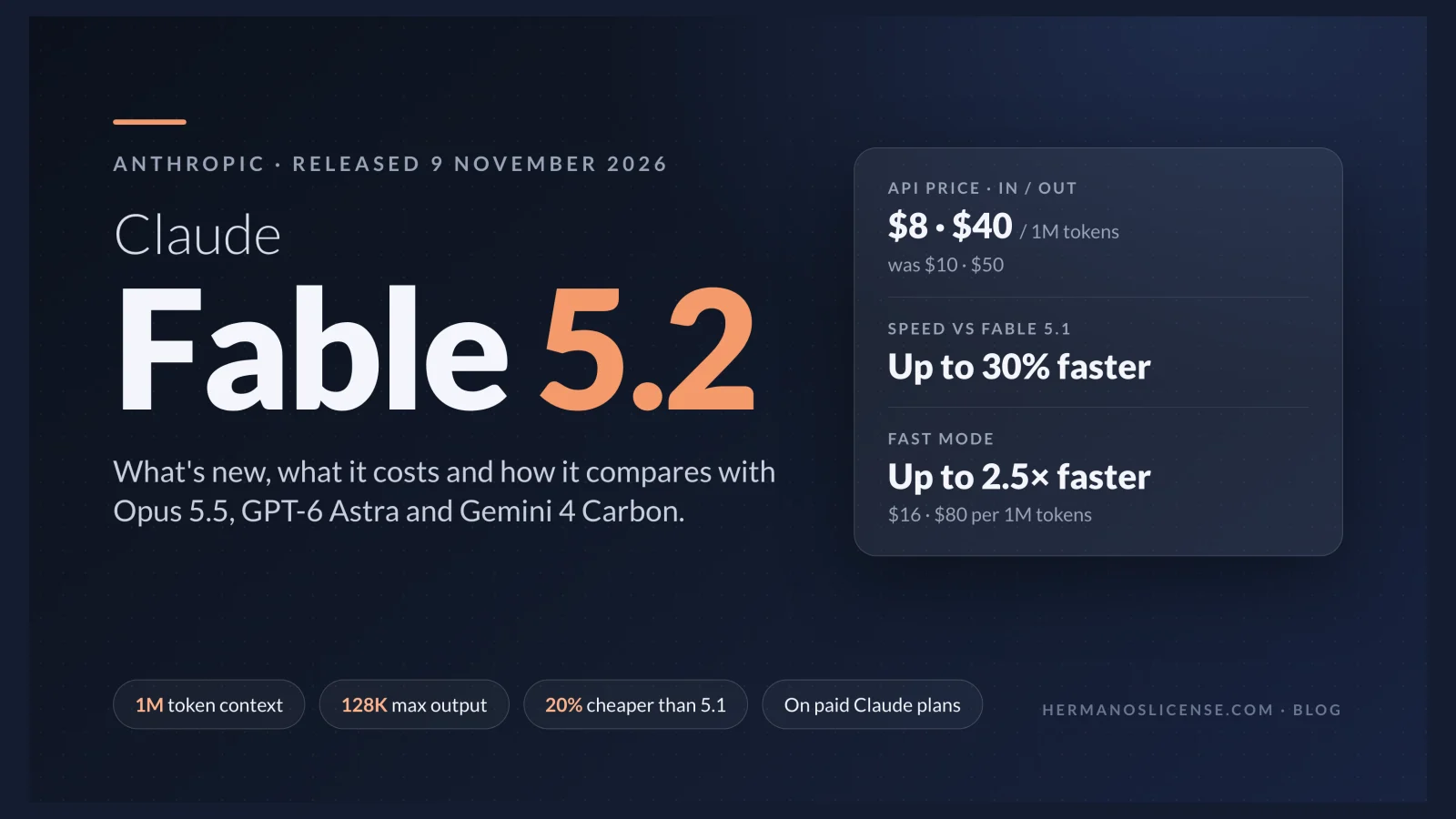
Anthropic released Claude Fable 5.2 on 9 November 2026. It is the most capable Claude model that anyone can sign up for, and it costs 20% less than Fable 5.1. Below: what changed, how it compares with Opus 5.5, GPT-6 Astra and Gemini 4 Carbon, and whether it is worth switching. Short on time? The first section sums it up in five lines.
Claude Fable 5.2 in 30 seconds
- What it is: Anthropic's top model for general release, built for hard reasoning and long, multi-step agent work.
- Price: $8 per million input tokens and $40 per million output tokens (tokens are the small chunks of text a model reads and writes), down from $10 and $50.
- Speed: answers arrive up to 30% faster than with Fable 5.1, and an optional fast mode is up to 2.5 times faster.
- Who it's for: developers, researchers and teams with genuinely hard problems. For everyday work, Anthropic still recommends Opus 5.5.
- Where: the Claude apps on paid plans (included on Max and Ultra, paid with usage credits on Pro), Claude Code, the Claude API and the big cloud platforms.
What's new compared with Fable 5.1
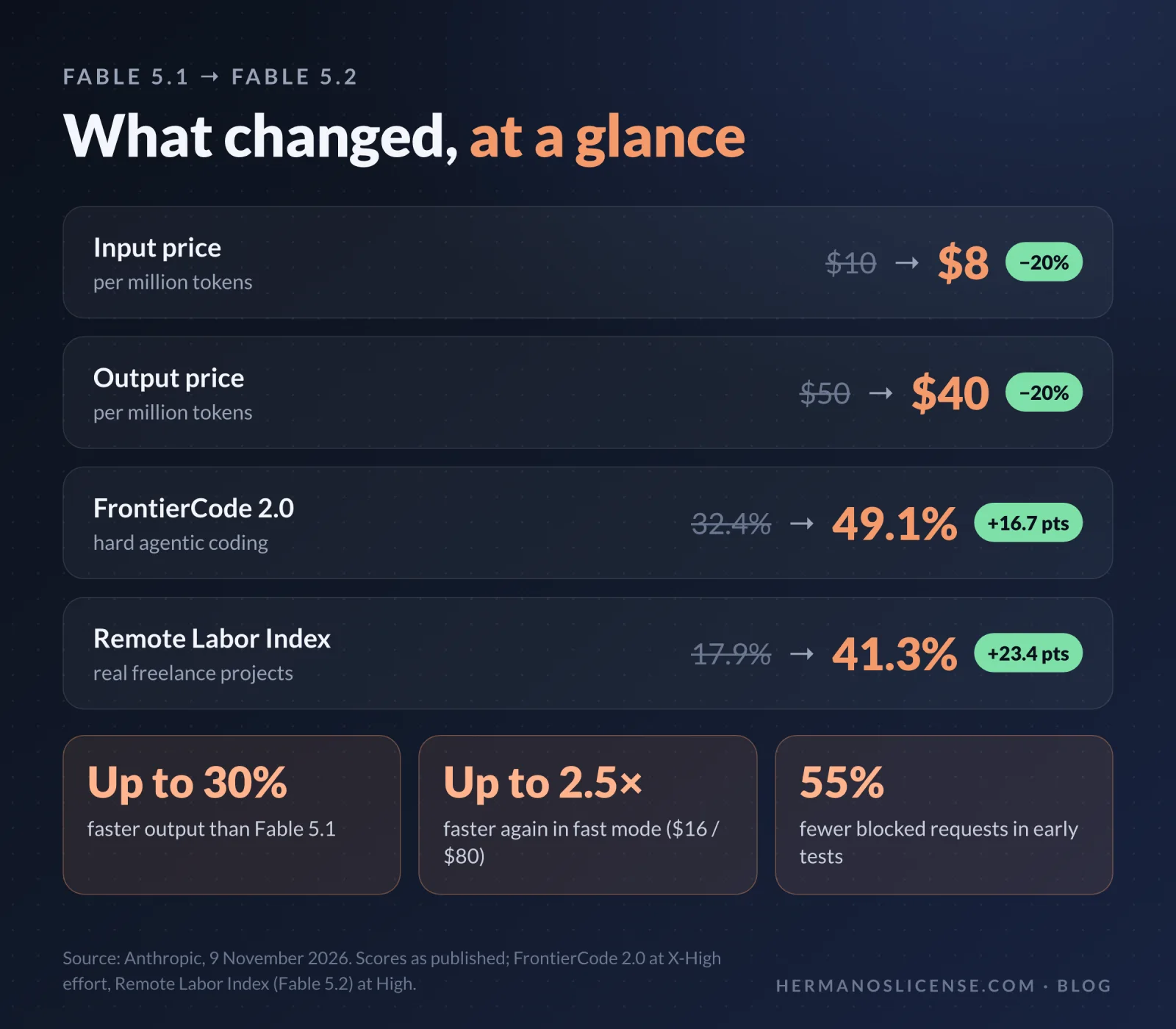
The upgrade comes down to four things: price, speed, results on hard tasks and fewer refused requests.
- A smaller bill. Input drops from $10 to $8 and output from $50 to $40 per million tokens. Reading from the prompt cache costs $0.20 per million.
- Faster answers. Output comes up to 30% faster. Need more? Fast mode is up to 2.5 times faster for double the price ($16 / $80).
- Big gains on the toughest tests. On FrontierCode 2.0, a hard agentic-coding benchmark, the score jumps from 32.4% to 49.1%. On the Remote Labor Index, built from real freelance projects, it climbs from 17.9% to 41.3%.
- Fewer false alarms. Anthropic says that in early testing its safety filters blocked about 55% fewer requests than with Fable 5.1, with the same cybersecurity and biology protections. A blocked request still gets an answer: Opus 4.8 handles blocked security questions and Opus 5 handles blocked biology questions.
Fable 5.2 vs Opus 5.5: which one should you use?
Anthropic's own advice is simple: start with Opus 5.5, which costs half as much ($4 / $20), and move up to Fable 5.2 when a task is too hard for it.
The gap shows on the hardest work. Fable 5.2 scores 69.9% on the FrontierSWE v2 coding test against 62.3% for Opus 5.5, and 74.2% against 67.7% on Humanity's Last Exam with tools. On AA-Briefcase, a test built from long, multi-week professional projects, the two are close: Opus 5.5 even edges ahead on the overall rating (1,800 to 1,785), while Fable passes more of the task checks (66.1% vs 61.2%).
Choose Fable 5.2 if you run long coding or research jobs, you need the best possible answer to a hard problem, or Opus 5.5 at high effort still falls short.
Choose Opus 5.5 if you want excellent everyday coding, writing and analysis for half the price.
One twist: the effort setting, which controls how much the model thinks before answering, changes the maths. Anthropic says Fable 5.2 at high effort scores about the same as Opus 5.5 at max effort on FrontierCode 2.0, for roughly half the cost per task. On heavy agent work, Fable can turn out to be the cheaper choice.
Fable 5.2 vs GPT-6 Astra and Gemini 4 Carbon
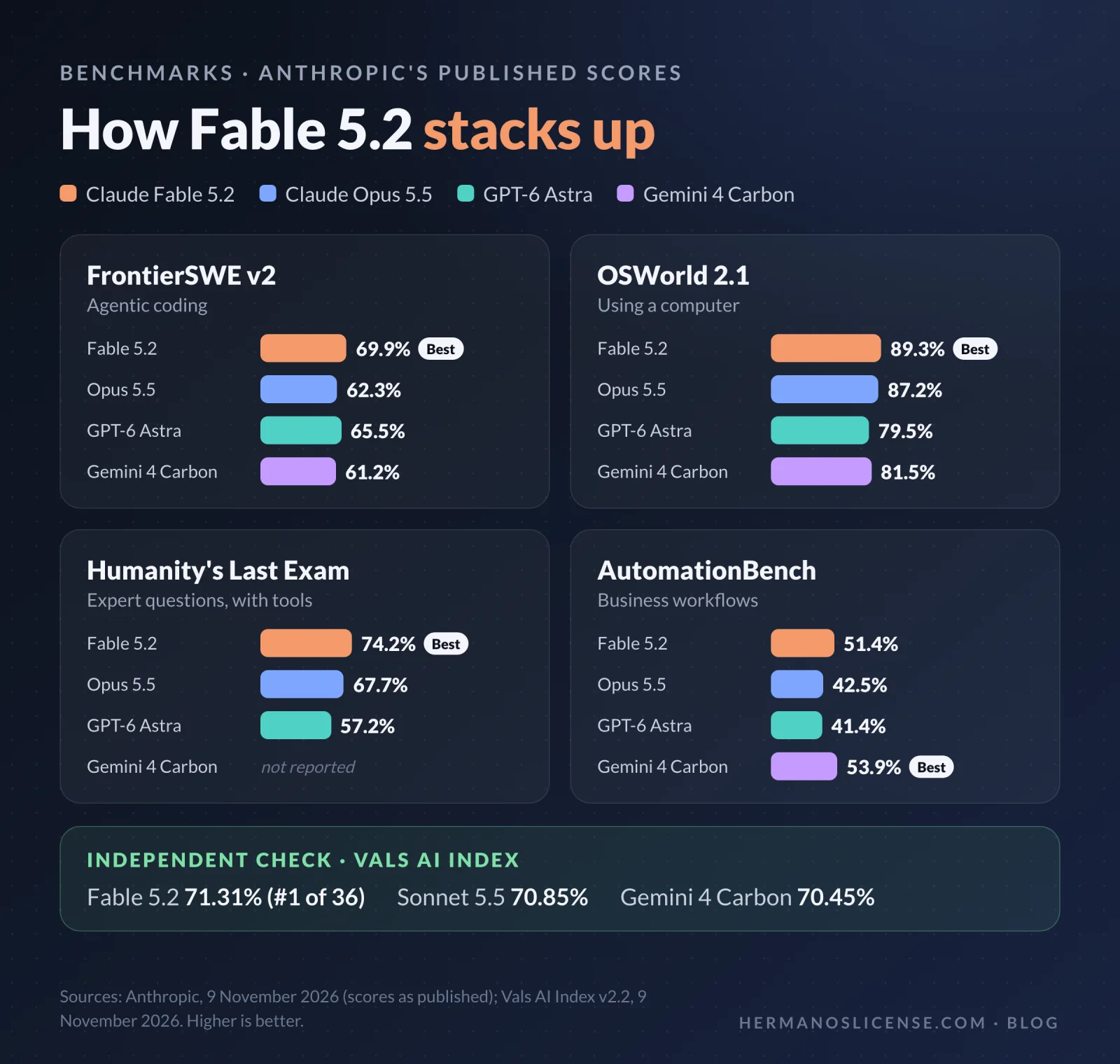
In Anthropic's published tests, Fable 5.2 beats OpenAI's GPT-6 Astra and Google's Gemini 4 Carbon on most benchmarks, though not on all of them. These are Anthropic's own numbers, so the independent results at the end of this section are a useful cross-check.
Fable 5.2 vs GPT-6 Astra
Fable leads on agentic coding (FrontierSWE v2: 69.9% vs 65.5%), on operating a computer (OSWorld 2.1: 89.3% vs 79.5%) and on Humanity's Last Exam with tools (74.2% vs 57.2%). GPT-6 Astra comes closest on chart reading (the Chartography test), where it trails by just 2.4 points (71.0% vs 73.4%).
Fable 5.2 vs Gemini 4 Carbon
This match-up is tighter. Gemini 4 Carbon wins AutomationBench, a test of business workflows (53.9% vs 51.4%), and trails by less than a point on chart reading. Fable is clearly ahead on coding and computer use. Google is still rolling Gemini 4 Carbon out to a small group of users, so most people cannot try it yet.
The independent view: Vals AI ran its own tests and puts Fable 5.2 first of 36 models on the Vals Index with 71.31%. The field is tight, though: Sonnet 5.5 scores 70.85% and Gemini 4 Carbon 70.45%. On SWE-bench Multimodal, Opus 5.5 still comes out ahead (70.21% vs 62.29%).
The Claude line-up at a glance
Fable 5.2 sits at the top of the models anyone can use. Prices are per million input / output tokens on the API:
- Haiku 5.5 (from $0.10 / $0.50): the fastest and cheapest, ideal for sorting, extracting and quick replies.
- Sonnet 5.5 ($2 / $10): the best balance of speed and intelligence for most apps.
- Opus 5.5 ($4 / $20): Anthropic's recommended everyday model for coding and knowledge work.
- Fable 5.2 ($8 / $40): for the hardest reasoning and long-running agents.
- Mythos 5.2: the same model as Fable 5.2 with looser cybersecurity and biology limits, available only to vetted organisations in Anthropic's verification programmes.
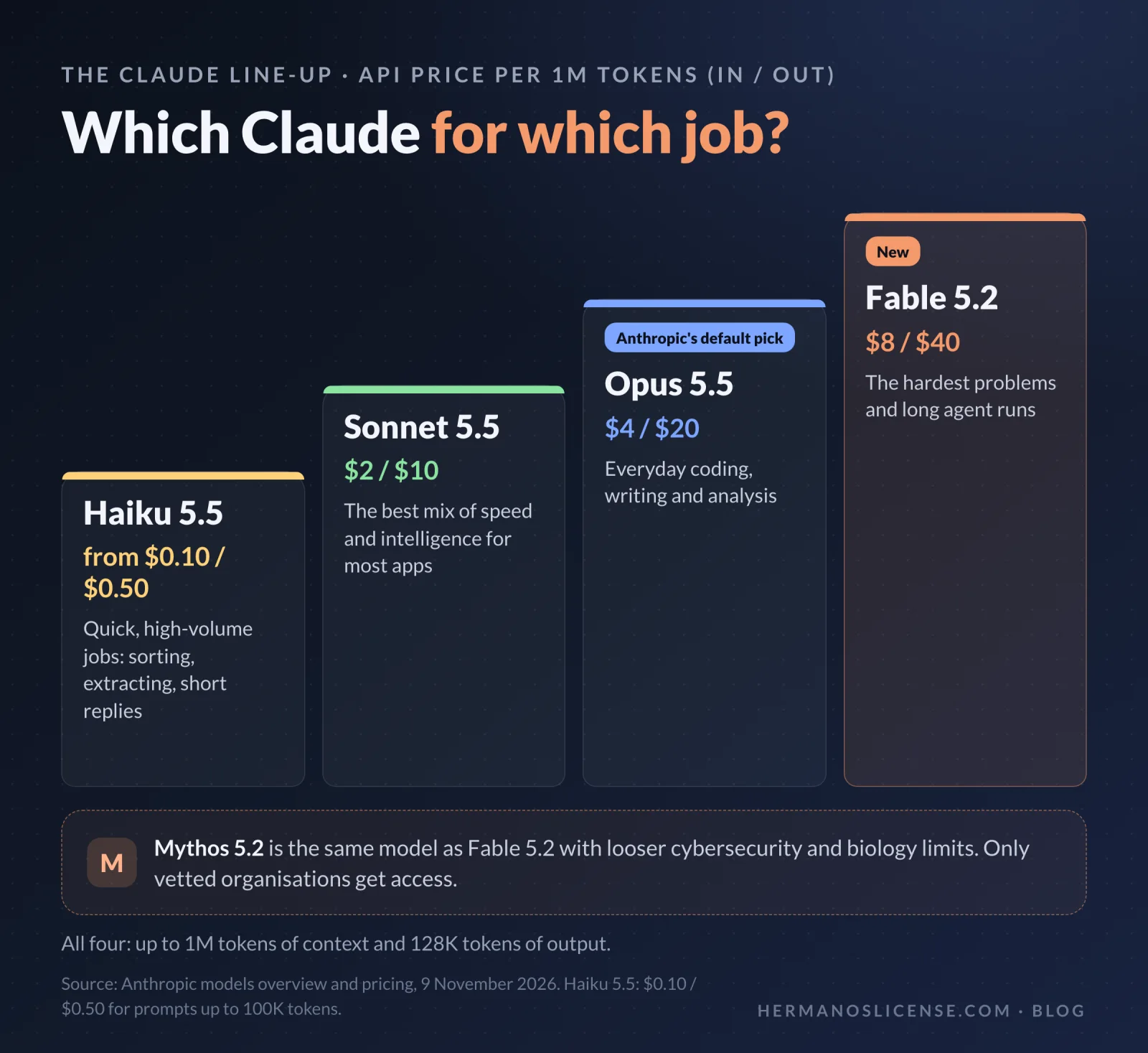
All four public models read up to 1 million tokens of context and can write up to 128,000 tokens in a single reply.
What Fable 5.2 costs in practice
Take one large request: 100,000 tokens in and 20,000 tokens out.
- Fable 5.1: $2.00
- Fable 5.2: $1.60
- Fable 5.2 in fast mode: $3.20, for output up to 2.5 times faster
Batch processing halves the standard price for jobs that can wait. The effort level matters too: higher effort means more thinking tokens, and so a bigger bill.
Where you can use Fable 5.2
- Claude app: the Max plan ($100 a month) and the Ultra plan ($200 a month, formerly called Max 20x) include Fable for up to half of their weekly usage limit, which Fable shares with your other models. Team and Enterprise include it on premium seats. On Pro and on standard seats you pay for Fable with usage credits, and the Free plan does not offer it.
- Launch offer for existing subscribers: if your subscription was already paid before 9 November (10:00 Pacific time), Pro plans and standard Team seats can use Fable for up to half of their weekly limit until 16 November and get one Fable reset. Max, Ultra and premium Team seats get one to three resets, depending on how long you have subscribed, usable until 8 March 2027. A reset restores your Fable usage; it does not raise your limit.
- Claude Code: available now, including fast mode. Medium effort is the default in Claude Code and the Claude apps; on the API the default is high.
- API and cloud: model ID
claude-fable-5-2on the Claude API, and also available on Amazon Bedrock, Google Cloud and Microsoft Foundry.
Should you switch?
- Using Fable 5.1 through the API? Yes. You get better results, faster, for 20% less. Change the model ID, read Anthropic's note on preserved thinking (a safeguard that now applies to every API account) and re-test your prompts.
- Developer on Opus 5.5? Keep it as your default and hand Fable 5.2 the tasks where Opus gets stuck.
- Everyday chat, writing or study? Opus 5.5 or Sonnet 5.5 handle this well. Fable draws on the same weekly limit and uses it up faster, so keep it for the hard jobs.
- Research, data or finance team? Worth a trial. Anthropic aims Fable 5.2 at exactly this kind of long, open-ended work.
Frequently asked questions
Is Claude Fable 5.2 free?
No. The Free plan does not include Fable. Max, Ultra and premium Team or Enterprise seats include it; on Pro you pay for it with usage credits, and on the API you pay per token.
What is the difference between Fable 5.2 and Mythos 5.2?
They are the same model. Mythos 5.2 has looser cybersecurity and biology safeguards and is only available to vetted organisations.
Is Fable 5.2 better than Opus 5.5?
On the hardest tasks, yes. For everyday work the two are close, and Opus 5.5 costs half as much.
How much text can Fable 5.2 handle?
Up to 1 million tokens of input and 128,000 tokens of output. Its knowledge is most reliable up to June 2026.
What is fast mode?
An optional setting that makes output up to 2.5 times faster for twice the price ($16 / $80). It works in Claude Code, on the Claude API, on Google Cloud and in Microsoft Foundry.
Where Hermanos License fits in
If you want Fable 5.2 inside the Claude app, the plan matters more than the model: Anthropic's $200 tier, formerly Max 20x and now called Ultra, includes Fable for up to half of its weekly limit. In our store, the Claude Max 20x subscription covers this tier; its product page explains exactly what you get and how delivery works. Weighing up Gemini too? Our AI tools category also has Google AI Pro (Gemini), Google's consumer plan; Gemini 4 Carbon itself is still in limited release.
Hermanos License is an independent store and is not affiliated with or endorsed by Anthropic.
Want more background? Read our guides to Claude Opus 5.5 and Claude Fable 5.1.
Sources: Anthropic's Fable 5.2 and Mythos 5.2 announcement, its model overview and plans and pricing, and Vals AI's independent results. Figures as published on 9 November 2026.