Claude Fable 5.1 Explained: What's New, What It Costs, and Which Plans Include It
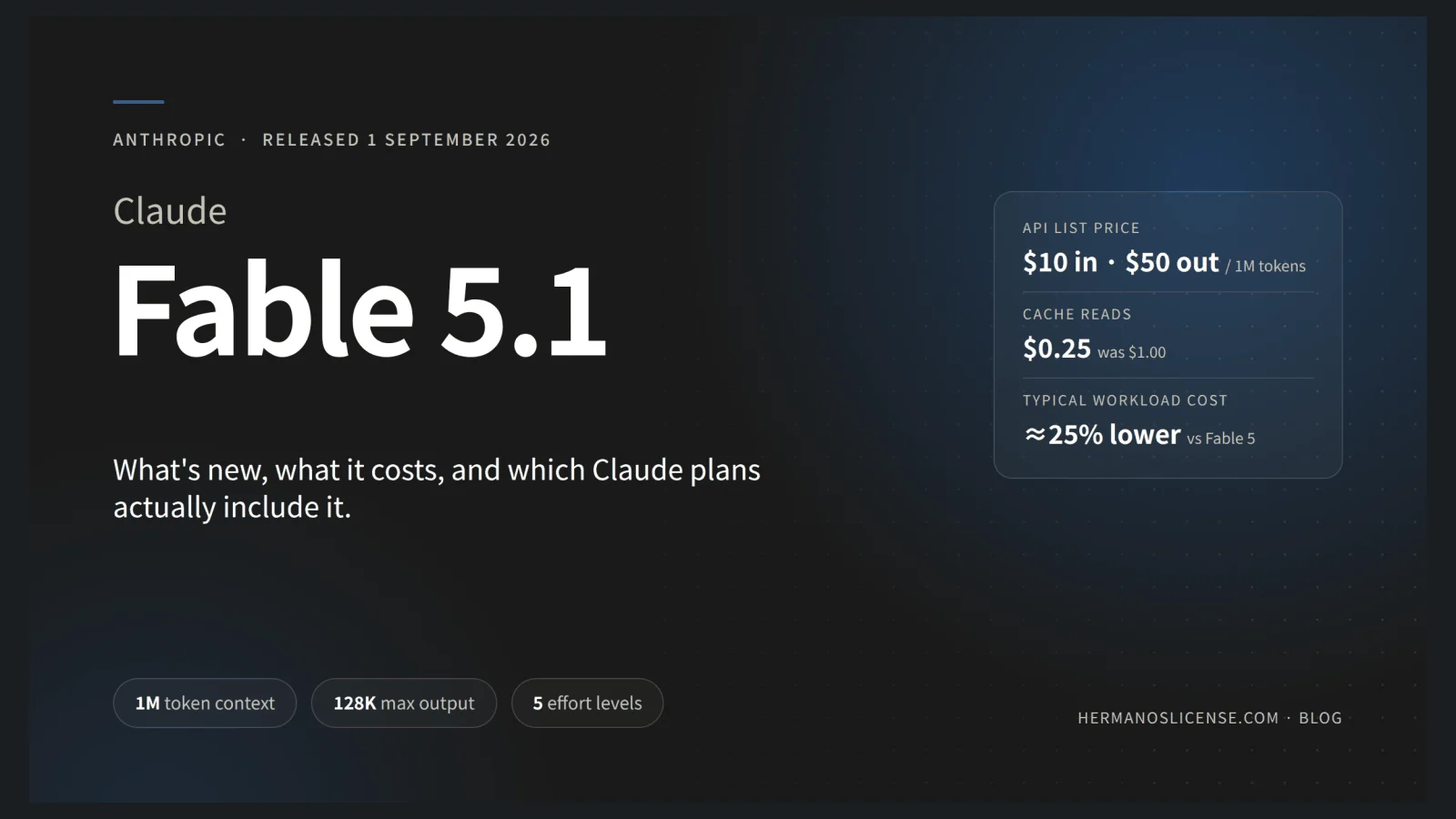
On 1 September 2026, Anthropic released Claude Fable 5.1, the follow-up to the Fable 5 model it launched in June. The headline is unusual for a frontier-model release: the list price did not go up, the model got measurably better at long, tool-heavy work, and the safety filters that frustrated some Fable 5 users now fire far less often. There is also a second name in the announcement, Claude Mythos 5.1, which is the same model with fewer guardrails, restricted to vetted organisations.
This guide explains what actually changed, with the numbers Anthropic published, what it costs through the API, which Claude subscription plans include it, and where it fits alongside the tools you may already be running. We have kept the marketing out and the figures in.
Fable 5.1 at a glance
| Item | Claude Fable 5.1 |
|---|---|
| Release date | 1 September 2026 |
| API model ID | claude-fable-5-1 |
| Context window / max output | 1,000,000 tokens / 128,000 tokens |
| Reliable knowledge cutoff | June 2026 |
| Effort levels | Low · Medium · High · X-High · Max |
| API list price | $10 per million input tokens · $50 per million output tokens · $0.25 per million cache-read tokens |
| Claude plans | Included on Max and Team Premium (up to 50% of weekly limits); usage credits on Pro and Team Standard; not on Free |
| Where it runs | Claude.ai, Claude Code, Claude Cowork, Claude API, Amazon Bedrock, Google Vertex AI, Microsoft Foundry |
| Sibling model | Claude Mythos 5.1 – identical weights, lighter safeguards, trusted-access only (US organisations for now) |
First, the family tree: Fable, Mythos and Opus
Anthropic's naming can be confusing, so it is worth a minute. For years the ladder was Haiku, Sonnet, Opus – small, medium, large. In 2026 a new tier appeared above Opus, which Anthropic calls Mythos-class. The full-capability version, Mythos, is only available to approved organisations through trusted-access programmes, because its cybersecurity and biology capabilities are considered too sensitive for open release. Fable is the same model, wrapped in classifier-based safeguards so that it can be sold to everyone.
The two are not "similar" models; Anthropic states plainly that Fable 5.1 and Mythos 5.1 are the same model with different levels of safeguards. When a Fable request trips a safeguard, it is handed to an Opus model instead, which is why Fable's published benchmark scores are slightly lower than Mythos's on tasks that touch security tooling. More on that below.
| Model | Who can use it | What it is for | API price (in / out, per 1M tokens) |
|---|---|---|---|
| Claude Mythos 5.1 | Approved organisations in Anthropic's trusted-access programmes; US-based only at launch | Defensive security research, professional life-science R&D | $10 / $50 |
| Claude Fable 5.1 | Anyone on a paid Claude plan or the API | Hardest coding, research and knowledge-work tasks; long unattended agent runs | $10 / $50 |
| Claude Opus 5 | All paid plans and the API | Strong general-purpose model; also the fallback for biology requests that Fable's safeguards redirect (Opus 4.8 handles cyber redirects) | $5 / $25 |
| Claude Sonnet 5 | Broadly available on Claude plans and the API | Fast everyday assistant and high-volume automation | $2 / $10 |
What's new in Fable 5.1
More capability per token: the effort dial
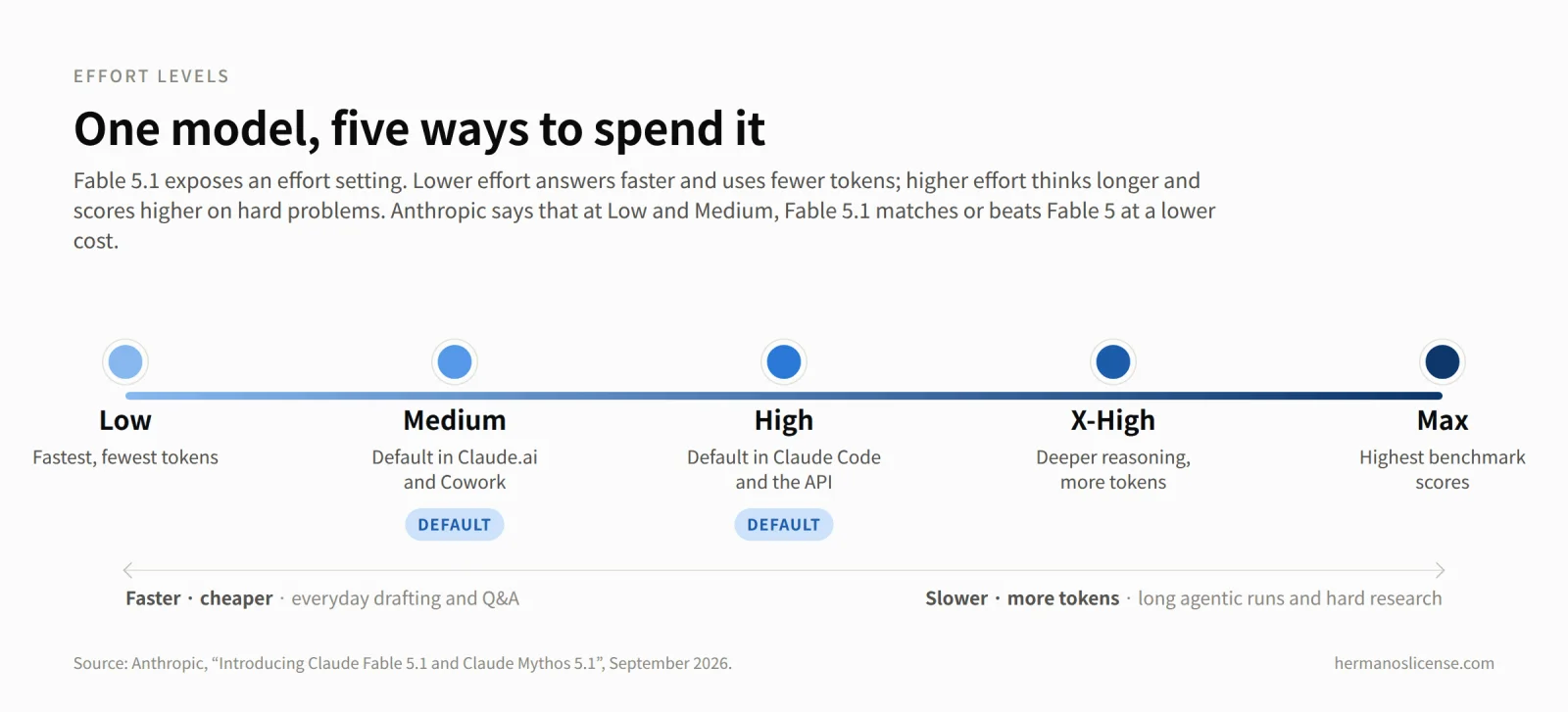
The most practical change is not a single benchmark but how the model spends compute. Fable 5.1 exposes five effort levels. At Low and Medium, Anthropic says the new model "achieves similar or better results than Fable 5" at a much lower cost, which is where most of the everyday saving comes from. At High, X-High and Max, it thinks longer and pulls clearly ahead of its predecessor on difficult problems.
You do not need to touch this in normal use. Claude.ai and Claude Cowork default to Medium; Claude Code and the API default to High. Developers and power users can turn the dial up for a hard refactor or a research run, and down for drafting and quick questions.
The benchmark picture
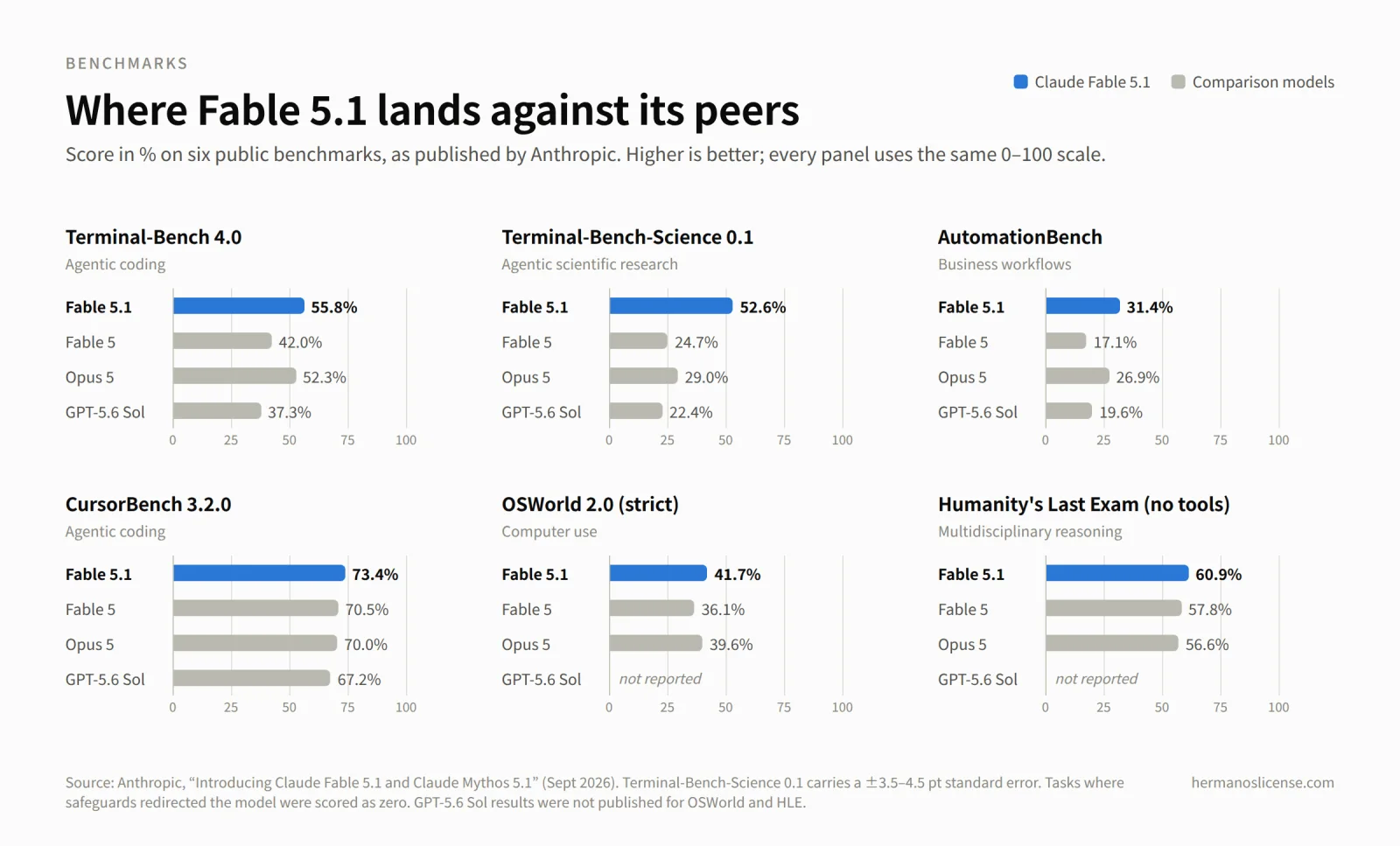
Anthropic published a comparison against Fable 5, Opus 5 and OpenAI's GPT-5.6 Sol. The biggest jumps are on benchmarks that reward sustained, multi-step work in a terminal or a browser rather than one-shot answers. On Terminal-Bench-Science, a test of agentic scientific research, Fable 5.1 more than doubles Fable 5's score. On AutomationBench, which simulates business workflows, it nearly doubles it. Gains on pure reasoning tests such as Humanity's Last Exam are real but smaller.
| Benchmark | What it measures | Fable 5.1 | Fable 5 | Opus 5 | GPT-5.6 Sol |
|---|---|---|---|---|---|
| Terminal-Bench 4.0 | Agentic coding | 55.8% | 42.0% | 52.3% | 37.3% |
| Terminal-Bench-Science 0.1 | Agentic scientific research | 52.6% | 24.7% | 29.0% | 22.4% |
| CursorBench 3.2.0 | Agentic coding (max effort) | 73.4% | 70.5% | 70.0% | 67.2% |
| AutomationBench | Business workflows | 31.4% | 17.1% | 26.9% | 19.6% |
| OSWorld 2.0 (strict) | Computer use | 41.7% | 36.1% | 39.6% | – |
| OSWorld 2.0 (partial credit) | Computer use | 77.9% | 72.9% | 75.4% | – |
| Humanity's Last Exam (no tools) | Multidisciplinary reasoning | 60.9% | 57.8% | 56.6% | – |
| Humanity's Last Exam (with tools) | Multidisciplinary reasoning | 65.0% | 63.8% | 63.6% | – |
| GDPval-AA v2 | Knowledge work (rating, not %) | 1853 | 1723 | 1824 | 1711 |
Source: Anthropic launch announcement, September 2026. Terminal-Bench-Science 0.1 carries a standard error of roughly ±3.5–4.5 points, so treat small gaps there with caution. Anthropic also notes that tasks where safeguards redirected the model to Opus were scored as zero, which slightly depresses Fable's numbers relative to Mythos 5.1 (60.9% on Terminal-Bench 4.0 versus Fable's 55.8%).
Built for work that runs for hours, not minutes
Benchmarks aside, the theme running through Anthropic's customer quotes is stamina. MongoDB describes leaving the model running unattended for hours with verification loops, waking to find the next phase finished, and completing a complex prototype in three days. Ramp reports a 38-hour unattended machine-learning run in which the model diagnosed a previous result as a labelling artefact, launched six parallel experiments, and came back with a result and next steps. Browserbase measured completion of its hardest browser-agent tasks – roughly ten minutes each – at 82% for Fable 5.1, against 74% for Opus 5 and 57% for Fable 5, using fewer tokens.
Shopify's engineer describes the qualitative difference well: a model that keeps its own records, reprioritises, and picks up where it left off without losing direction. That is the capability Anthropic is really selling with 5.1: not a smarter chatbot, but an agent you can hand a multi-hour job to. It matters for Claude Code users in particular, where the default effort is already High and the model is expected to work through a codebase on its own.
Writing, research and everyday knowledge work
Not every buyer is a developer, and the 5.1 gains are not confined to code. Glean ran blind comparisons on everyday knowledge work – research, drafting, high-intent questions – and reports judges preferred Fable 5.1's answers two to one over Fable 5. Canva says the writing is more understandable and meaningful, follows guidance better, and beat Fable 5 in blind tests. Hebbia, whose users work on financial documents, calls the PowerPoint decks it produces the best of any model it tested, with the best fact recall on citations. On GDPval-AA v2, a third-party rating of real-world professional tasks, Fable 5.1 scores 1853 against 1723 for Fable 5.
A glimpse of the research use
Anthropic used the launch to show what the model does when pointed at open scientific problems. Three examples stand out. In protein binder design, the model hit a success rate of "nearly 50% across 12 targets", where 10–15% is typical, and produced binders with roughly ten times the affinity of the best competition entries on three targets. Using thirty-year-old NASA Magellan radar data, it produced an elevation map of a third of Venus at two-to-three-kilometre resolution, where previous maps managed ten to twenty, released under a Creative Commons licence. And it rewrote GPU kernels for seven open-source protein and genomics models, speeding them up 1.4 to 2.5 times on NVIDIA H100s, work that Anthropic says took days rather than the usual weeks.
Be aware that the advanced biology work runs under Mythos-level access through the Life Sciences Verification Program, not the public Fable 5.1, which keeps its biology safeguards.
Pricing: what changed and what didn't
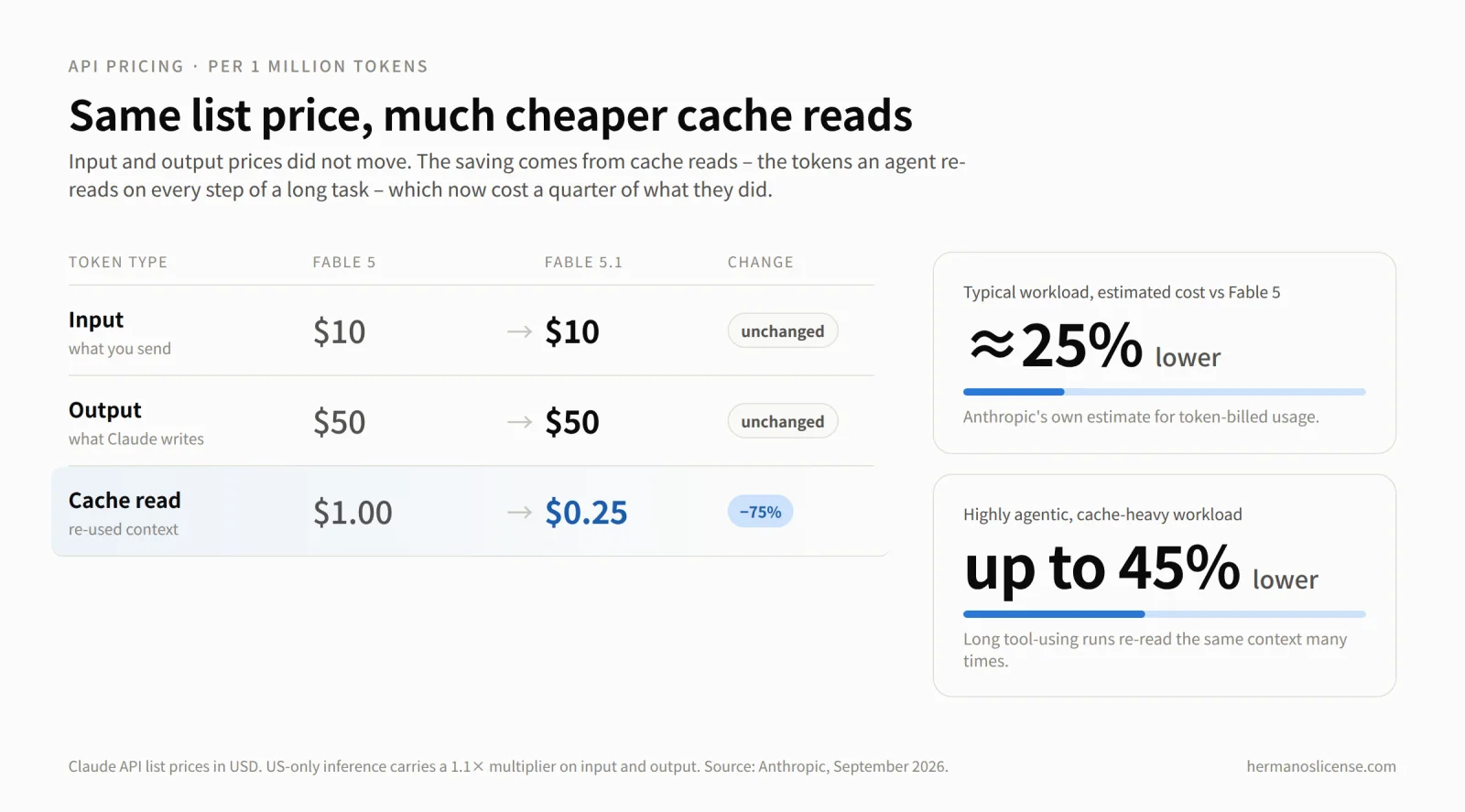
Through the API, Fable 5.1 costs exactly what Fable 5 did per token: $10 per million input tokens and $50 per million output tokens. The change is in cache reads, which fell from $1.00 to $0.25 per million tokens, a 75% cut.
If you are new to the term: when Claude works on a long task, it re-reads the same instructions, files and conversation history on every step. Prompt caching lets the API store that repeated context and charge a reduced "cache read" rate for it instead of full input price. For an agent that takes hundreds of steps, cached tokens dominate the bill. That is why Anthropic estimates the effective cost of Fable 5.1 at about 25% lower than Fable 5 for typical workloads and up to 45% lower for highly agentic ones, even though the sticker price is unchanged. Several customers report additional savings simply because 5.1 finishes tasks in fewer tokens: Every says it used half the tokens of Opus 5 at twice the speed, and Rogo matched Fable 5's accuracy on its finance benchmark with 20% fewer tokens.
| Per 1M tokens | Fable 5 | Fable 5.1 | Opus 5 | Sonnet 5 |
|---|---|---|---|---|
| Input | $10.00 | $10.00 | $5.00 | $2.00 |
| Output | $50.00 | $50.00 | $25.00 | $10.00 |
| Cache read | $1.00 | $0.25 | see current API price list | |
| Estimated cost vs Fable 5, typical workload | – | ≈ 25% lower | – | |
| Estimated cost vs Fable 5, highly agentic workload | – | up to 45% lower | – | |
API list prices in USD from Anthropic's model documentation and launch announcement. US-only inference carries a 1.1× multiplier on input and output. Subscription plans (Pro, Max, Team) are billed monthly, not per token; see the plan section below.
Safeguards: fewer false alarms, same red lines
This is the part Fable 5 users will care about most. Fable 5's June launch was bumpy: access was suspended on 12 June under a US government directive that followed a reported safeguard-bypass technique, and restored on 1 July, once the controls were lifted, with a stronger classifier. Those classifiers kept the model safe, but they also interrupted legitimate work, such as developers asking about vulnerabilities in their own code or people asking basic biology and medical questions.
Fable 5.1 keeps the same architecture – a classifier watches each request, and anything flagged is handed to an Opus model, with a notice in the reply – but the classifiers are considerably more precise. Anthropic reports around 60% fewer cyber-safeguard interventions per session than Fable 5, and 85% fewer false positives on elementary biology and medical questions. Claude Code users see the same 60% reduction in cybersecurity false positives. One practical change: Fable 5.1 may now identify software vulnerabilities in code, which is routine work for developers. Generating exploits, penetration testing and binary vulnerability scanning still redirect to Opus.
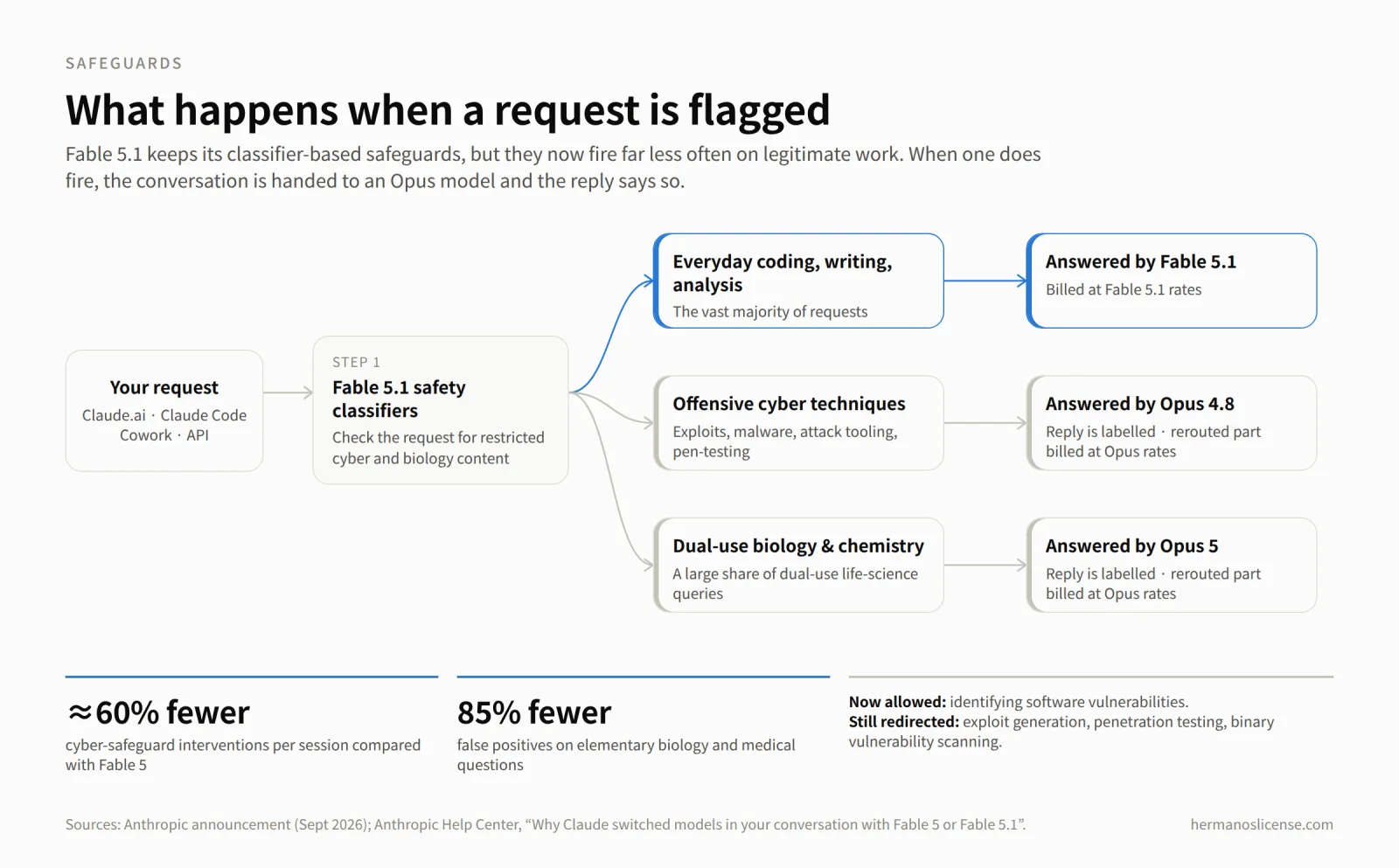
| If your request is… | Who answers | What you see | What you pay |
|---|---|---|---|
| Everyday coding, writing, analysis, research (the vast majority) | Fable 5.1 | A normal reply | Fable 5.1 rates / plan usage |
| Offensive cyber techniques – exploits, malware, attack tooling | Opus 4.8 | A notice that the model switched; reply labelled | Opus rates for the rerouted part (if blocked before generation starts, Opus rates only) |
| Dual-use biology, chemistry or life-science requests | Opus 5 | A notice that the model switched; reply labelled | Opus rates for the rerouted part |
Two other safety notes from the launch are worth knowing. Anthropic says Fable 5.1 is its most robust model to date on an external prompt-injection benchmark, which matters when an agent reads untrusted web pages and documents. And for enterprises, a programme called Enterprise Frontier Safeguards is rolling out from autumn 2026 that keeps safeguard data and any human review inside the customer's own cloud, on AWS, Google Cloud or Azure, with privacy equivalent to a zero-data-retention policy.
Watermarking, anti-distillation and the EU AI Act
Fable 5.1 ships with an invisible statistical watermark in its text output. Anthropic signed the EU's Code of Practice on Transparency of AI-Generated Content in July 2026, alongside 190 other organisations, and this is its implementation. The watermark is a statistical signal that lets a detection tool estimate the likelihood that Claude was involved in producing a text. Anthropic says it has "no practical impact on the quality or content of Claude's outputs" and contains no information about the user, their organisation, or the conversation. A detection API is in private preview for regulators, fact-checkers, researchers, educators and organisations with their own verification obligations under the Act.
Separately, Anthropic has closed a common model-distillation technique: new API accounts can no longer manually edit earlier turns of a conversation while keeping the model's prior reasoning transcript. Existing accounts are unaffected for now, and Anthropic expects only a small number of custom integrations to notice.
Which Claude plan actually includes Fable 5.1?
This is where the fine print matters. Fable 5.1 is not on the Free plan, and it is not the default model on any plan – you select "Fable 5.1" from the model picker on web, desktop or mobile. How it is billed depends on the plan.
| Plan | Fable 5.1 access | How it is billed |
|---|---|---|
| Free | No | – |
| Pro | Yes | Pay-as-you-go usage credits; Fable usage sits outside the plan's normal limits |
| Max 5x and Max 20x | Yes, included | Up to 50% of your weekly usage limits at no extra cost; beyond that, usage credits or switch model |
| Team Standard | Yes | Usage credits |
| Team Premium | Yes, included | Up to 50% of weekly limits at no extra cost, then usage credits |
| Enterprise | Yes | Premium seats included; standard seats via credits; usage-based contracts at API rates |
| Claude API | Yes | Standard API rates listed above |
A few practical details. In Claude Code, Fable 5.1 requires version 2.1.250 or later. In Cowork, you need the latest Claude Desktop. The "50% of weekly limits" rule on Max and Team Premium is a capacity guardrail, not a penalty: you can spend half of your week's allowance on Fable and the rest on Opus or Sonnet, or keep going on Fable with credits. Because several customers report Fable 5.1 finishing tasks in fewer tokens than Fable 5, that 50% may stretch further than it did in July.
Which plan makes sense? If you want Fable 5.1 as a daily driver rather than an occasional splurge, the maths favours Max. On Pro, every Fable conversation draws on paid usage credits; on Max, half your weekly allowance is already included. Max 20x is the tier built for Claude Code and long agent sessions, with twenty times Pro's session capacity.
Where Hermanos License fits in
Claude Max 20x subscription. The tier where Fable 5.1 is included rather than metered, with full Claude Code and Cowork access and priority during traffic spikes. Availability changes; the product page shows live stock, price and delivery details, and the order is covered by our 15-day store support.
Fable 5.1 is at its best when it has real work in front of it, and most of that work happens in software you already own or should. A few pairings that make practical sense:
| If you use Fable 5.1 for… | It pairs well with | Find it in |
|---|---|---|
| Research, writing and comparing sources | A second assistant for cross-checking – the Google AI Pro (Gemini) 18-month plan in our store also bundles 5 TB of Google storage | AI Tools |
| Coding and Claude Code sessions | A properly activated Windows 11 Pro machine for local development – Pro adds Hyper-V, Windows Sandbox, BitLocker and Remote Desktop hosting over Home | Windows 11 |
| Decks, reports and financial analysis | Microsoft Office, so the .pptx and .xlsx files Claude produces open exactly as intended | Office Licenses |
| Process diagrams and project plans | Microsoft Visio and Project – Fable 5.1 drafts, you refine | Visio & Project |
| Design work and UI prototypes | Figma Pro or CorelDRAW to take Claude's mock-ups to finished artwork | Graphic Design Tools |
| Reading PDFs, contracts and scanned documents | Adobe Acrobat Pro for editing and signing what Claude has summarised | Adobe Acrobat Pro 2020 |
| Agents that browse the web on your behalf | Endpoint protection and a VPN, since browsing agents open pages you never see | Antivirus & VPN |
All licences and subscriptions on Hermanos License are delivered digitally. Claude subscriptions remain subject to Anthropic's Consumer Terms, including session and weekly limits. If you are unsure which product fits, contact us before you buy.
Frequently asked questions
Is Fable 5.1 a new model or an update to Fable 5?
A new release of the same model family. Anthropic positions it as its most advanced generally available model, ahead of Fable 5 and Opus 5 on every benchmark it published, with the same API price and a lower effective cost.
What is the difference between Fable 5.1 and Mythos 5.1?
None in the underlying model. Mythos 5.1 has lighter cybersecurity and biology safeguards and is only available to approved organisations through Anthropic's verification programmes, currently US-based ones. Fable 5.1 is the version anyone on a paid plan can use.
Can I use Fable 5.1 on the Free plan?
No. It is available on Pro (via usage credits), included on Max and Team Premium up to 50% of weekly limits, and on Team Standard and Enterprise via credits or contract. It is never the default model, so pick it from the model selector.
Why did my Fable 5.1 conversation suddenly switch to Opus?
A safety classifier flagged the request as touching offensive cybersecurity or dual-use biology. The reply is labelled with the model that answered, and the rerouted part is billed at Opus rates. Anthropic says these interventions happen around 60% less often than on Fable 5 for cyber topics and 85% less often for basic biology questions.
Does the watermark change what Claude writes?
According to Anthropic, no. It is a statistical signal that a detection tool can measure; it is invisible to readers, carries no information about you or your conversation, and does not alter quality or content.
Sources
Anthropic, Introducing Claude Fable 5.1 and Claude Mythos 5.1 (1 September 2026) · Anthropic, Claude Fable product page · Anthropic, Models overview (context window, output limits, pricing) · Anthropic Help Center, Claude Fable models on your plan · Anthropic Help Center, Why Claude switched models in your conversation · Anthropic, Redeploying Claude Fable 5 (July 2026). Benchmark figures and customer quotes are Anthropic's own published numbers; we have not independently verified them.